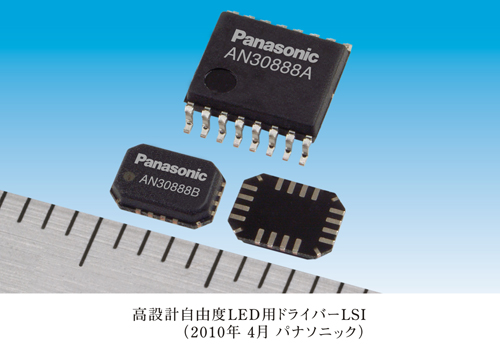
Panasonic - Develop the market's first LED Driver LSI that provides high flexibility in design

Sample shipment starts from end of May 2010
* Based on current market investigation on 22 April 2010

[Overview]
Panasonic Semiconductor Company is developing the market's first LED Driver LSI that provides high flexibility in design. This LSI caters for wide power supply range and provides power supply to LED system for various applications. Based on PWM input, light adjustment function or luminance setting can be easily achieved which makes design using this LED driver LSI (Product number: AN30888A/AN30888B) highly flexible. Sample shipment starts from end of May 2010.
[Advantage]
By using this product, boost/buck/boost-buck output system can be achieved by simply changing the external circuit. With wide power supply range of 3~20V, the design for LED application becomes highly flexible. As various power supplies including battery operation are supported, an optimum output system which satisfies the power supply and number of LED used can be set.
[Characteristics]
The characteristics of this product are as shown below.
- Design flexibility of boost/buck/boost-buck output system can be achieved by changing the external circuit
- A wide operating power supply range allows configuration of power supply and number of LED to drive according to specific application.
- High flexibility in light adjustment function by using multiple luminance setting methods such as reference voltage control and PWM control.
[Contents]
This product is achieved using the technologies described below.
- LED driver current stabilizing technology whereby stable LED luminance can be achieved by using boost/buck/boost-buck for all the output system.
- Stability control circuit technology which makes up for the variation in the wide range of power supply and maximum duty compensation technology which compensates the possibility of output voltage instability due to effects from power supply variations during boost/buck configuration.
-
Choice of high precision LED driver current control or high efficiency output current control are available with feedback technology; and PWM light adjustment technology which changes the pulse width to achieve switching control.
-
With high precision mode, LED driver current variation within ±3% can be achieved.
(Existing is ±5%.) -
With high efficiency mode, the driver efficiency is improved by 1.6%.
(This is with respect to the high precision mode of which the efficiency is 90%.)
-
With high precision mode, LED driver current variation within ±3% can be achieved.
[Conventional example]
For conventional LED driver LSI, power supply and LED supply power is based on respective application and a separate LSI control for boost/buck/boost-buck is required. Hence from the set maker's viewpoint, an integrated LSI of high design flexibility which can switch between boost/buck/boost-buck configurations and operate at a wide power supply range is needed.