SMC: Moisture Control Tubing: Series IDK

Small pneumatic actuators and grippers are great for space saving, high speed automation tasks, but the amount of compressed air required to operate them may be so little that they are not effectively exhausted/refreshed via a long tubing run. When this happens, moisture in your air line has an opportunity to condense and collect as water in your actuators. The result: reduced component life, impaired cycle rates, increased down time and increased costs.
Protecting your components and process is as simple as replacing the last few inches of tubing going into your actuators. SMC's new moisture control tubing is a unique pneumatic drying product that can eliminate moisture problems before they damage your equipment. It removes the moisture without any additional energy requirements and is used only where needed. It is an economical solution when just a few remote actuators or air operated valves are experiencing problems.

Features:
- Removes moisture at the point of use
- Maintains the life of small cylinders, air pilot operated valves, etc.
- Quickly and easily installed where needed
- Space saving
- No operating costs
Other drying options can have several drawbacks. Membrane and desiccant dryers can reduce the dew point of the air to the point where the grease in the actuators can be dried. Membrane dryers require purge air to function and desiccant dryers require electricity to dry the media for reuse. Both options require more space than simply replacing a few inches of tubing and would be more costly than using IDK moisture control tubing.
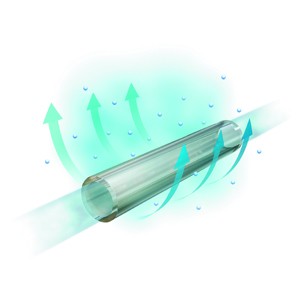
How does it work? IDK tubing is made from a fluorine resin that is permeable to moisture. As the humidity of the compressed air increases in the actuator and adjacent tubing, this moisture migrates from inside the tubing to the outside where the ambient air has a lower relative humidity. By maintaining the humidity at a reduced level, it does not have the opportunity to condense into water and damage the cylinder.
Why are small actuators or valves at the end of a long run of tubing likely sites for moisture issues? If the volume of the tubing is significantly higher than that of the actuator, then the actuator may be able to exhaust into the tubing without any real travel of the air back to the directional control valve. Shifting the control valve to repressurize this line tends to involve little mixing of the fresh air with that which remained in the line. Instead, the air molecules near the actuator are pushed back into the cylinder. Compressing and expanding this stale air thru the ports of the actuator introduces a heating and cooling cycle which can lead to condensation of vapor into liquid. Once water has formed, grease can be washed out of the cylinder and/or corrosion can occur.
IDK moisture control tubing is designed for use with One-touch fittings, so installation is a snap. Simply disconnect your tubing from the actuator, insert the IDK tubing into the fittings, and connect your tubing to the IDK with unions. The largest size only adds 16g to your assembly including the unions.
Small pneumatic grippers and other actuators can be expensive to replace. Basic cylinders are less costly, but maintenance costs and downtime can quickly add up. IDK tubing is a small and simple investment to make in your system to prevent moisture problems and maximize the life of your actuators.