P + F: Rotational Speed Detection for Slip Monitoring

Correct dispersion ensured
Highly functional logic control units for slip detection
When transferring high mechanical power, slip monitoring between the drive and output is required as overload protection. Thermal monitoring is excluded due to its inertia, as a blocked system transfers enormous power in fractions of a second. In addition to damaging the transfer elements, sparks can be generated: a side effect that should be avoided in hazardous areas. Rotational speed monitors are particularly suitable due to their fast response.
Common mixing operations
The introduction of powders (dusts) into liquids is performed on a daily basis in many areas of process automation. In the food industry, such as dairy products, chocolate, or in the production of toothpaste, cosmetics or hairspray, solids must be in introduced into media of varying viscosity. If the powder is only poured on the surface of the liquid and stirred, there is the issue that the powder doesn’t mix properly, but more importantly dust settles on the machine parts, not to mention the side effects of inhalation by operating personnel.
TDS – for dust prevention
Since lumps and deposits are not acceptable for quality and safety reasons, TDS induction mixers are the ideal solution for dust prevention and powder wetting. These inline machines work according to the rotor/stator principle with high shear rates. TDS machines induct the powder directly from a bag into the liquid. Thepowder is wetted and dispersed with no lumps. The process takes place with a high shear gradient in a rotor/stator system that can be adjusted for different tasks.
Beware of jamming
The system can be subject to blocking due to:
- Foreign objects
- Highly-viscous media
- Media that solidifies in a cold state
Such blocking requires a fast reaction, particularly in hazardous areas, in order to avoid damage to the system and prevent impermissibly high (surface) temperatures.
Therefore, between the drive and TDS system there is a torque-dependent coupling that abruptly disengages when a previously set drive train torque is exceeded.
However, in the event of a fault or incomplete disengagement of the coupling elements, there is the danger of high surface temperature or even spark formation as a result of the high energy generated. This situation must be prevented for explosion protection. Initiators on the drive and on the output side constantly detect both rotational speeds and compare them for slip. The occurrence of slip is immediately detected and the drive can be switched off before a dangerous situation occurs.
Protecting non-electrical apparatus in the dispersing plant
The explosion protection of non-electric apparatus is not possible without a basic knowledge of reliable ignition risk assessment. If the ignition risk assessment shows that a potential ignition source exists, measures must be taken to eliminate the risk. Hot surfaces can ignite a potentially explosive atmosphere if the ignition temperature is exceeded. When a great deal of mechanical energy is transferred in a small space, the temperature can increase considerably due to friction losses under normal operation and in faulty operation (predictable fault). All surfaces of the device that come into contact with the surrounding atmosphere must be considered.
In rapidly rotating systems, such as the TDS, temperature increases may occur due to mechanical energy transfer in the medium. A temperature monitor is essential so that every temperature increase is reliably detected, and extremely high surface temperatures are prevented. Simultaneously, the temperature detection to control the process temperature can be used to prevent damage to the product and protect it from overheating. Friction or impact sparks can occur if metal components strike each other. These friction and impact sparks can occur during blocking of couplings, are controlled by slip monitoring, and because of potential differences, electric sparks can occur. However, this can be prevented with equipotential bonding.
Slip monitoring
"Slip" generally refers to the speed difference between mechanical elements or fluids in frictional contact, under tangential stress. In order to prevent premature damage to slipping clutches, conveyor belts and drive belts, the difference in rotational speeds between drive and output side are evaluated.
Slip monitoring must be clearly distinguished from synchronization monitoring. Synchronization monitoring compares the number of pulses, while slip monitoring compares the frequency of the drive and output side. With slip monitoring, a short-term slip (different frequency) within limits is tolerated and then "forgotten." At the next slip occurrence, this is again evaluated without taking history into consideration.
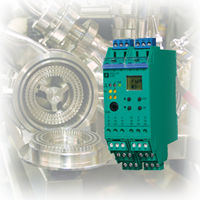
Modern slip monitoring, such as the KFD2-UFT-EX2.D logic control unit from Pepperl+Fuchs, allows slip monitoring of couplings with downstream gear units or conveyor belts with transmission ratio. In addition, the input frequency is converted into an analog 0/4-20 mA signal output.