The New Megatrend: Convergence in Manufacturing

Manufacturers face unprecedented challenges as global economic forces drive competition and open opportunities in new markets. Flexibility and efficiency are required to quickly develop and manufacture an increasing number of products to meet rapidly changing demands. At the same time, manufacturing companies are becoming more complex and globally dispersed, accelerating the need for increased collaboration, visibility and efficiency.
CEOs recognize that to achieve these business objectives and be competitive in a global manufacturing environment, their organizations need to do a better job of getting the right information to the right people at the right time, in the right place, in a usable, integrated format in order to make quick, smart business decisions. The organization must become more responsive to changing market and operational conditions without sacrificing efficiency.
Ultimately, network convergence helps align technology with business goals. These goals typically include increased agility and responsiveness, a cost-effective strategy for business process transformation, and enterprise-wide visibility.
However, challenges exist to this alignment. Manufacturers have many systems and layers that may not communicate. Information needs to move quickly between supply chains, distribution chains, the people and equipment on the manufacturing floor and the company’s decision makers. Development and integration of applications and systems can be costly and time-consuming without ample coordination. And silos in organizational structures between IT and manufacturing can result in poor information exchange and resource allocation, and integration challenges.
.jpg)
Figure 1
Manufacturing Convergence Model
Enter the convergence trend. In simplest terms, the deployment of Ethernet has pulled IT and manufacturing professionals together, often creating turmoil, but often creating opportunity to improve efficiencies, drive company-wide best practices and provide transformational change that improves the competitiveness of manufacturers.
The model shown in Figure 1 helps define the different components of manufacturing network convergence and address challenges in each area.
Technology and Network Convergence
Increased business pressures, along with wide deployment of standard, unmodified Ethernet on the plant floor and across the enterprise, help drive the convergence of manufacturing and IT technologies, organizations and cultures. Integrated, connected networks share information and run multiple applications over the same network. Network convergence allows integration of business and manufacturing systems, and helps lay a foundation for more innovative business models. By converging networks, manufacturers benefit from remote access and support, fewer networks to maintain as well as the visibility and integration of technologies and communications.
The entire system of people, networks, applications and devices needs to be considered to best understand impact to an organization. This includes incorporating machine builders in system design, alignment of technical design with business needs and strategic thinking around the role of technology in solving the ultimate business objectives.
EtherNet/IP™: The Pathway to a Single Network Architecture
Ethernet has been the de-facto standard for business enterprise systems for many years Ethernet has been very popular for many years as a programming and HMI network in industrial automation because of its speed and ability to handle large amounts of data, such as the download of a programmable controller program. As the technology moved from 10M and hubs to 100M and switches, vendors added many more automation products and expanded Ethernet’s usage to include most, if not all, of the space occupied by traditional fieldbusses. Customers are adopting Ethernet rapidly because it has now been proven to work well, handles a variety of applications, and is relatively well known because of its use in the business enterprise.
Among the variations of Ethernet used in industrial applications, EtherNet/IP seems to be ranked second, only to native
The industry adoption of EtherNet/IP for control and information has enabled of network convergence between manufacturing and enterprise networks. EtherNet/IP is the world’s leading industrial Ethernet network for a number of reasons. First, it is capable of handling the widest range of applications, including discrete, safety, motion, process and drive applications. Several Ethernet derivatives are limited to niche applications, either by design or by the narrow range of products that are currently available on the network.
What major changes in industrial Ethernet, in general, and EtherNet/IP specifically are coming in the near future? 2010 and beyond?
The use of standard wireless Ethernet (IEEE 802.11N) is going to become much more significant in industrial networking. The latest standard added many things needed to provide the stability required for industrial applications. Also, there will be a lot more innovation and improvements around physical media and cabling and different ways of transmitting the Ethernet signals, whether that’s media that works well in hazardous or explosive areas or media that carries both power and signal. These technologies will be refined and will allow for easier deployment and more flexibility in how to get those signals from point A to point B.
We also expect additional refinements that will help make the user experience even better with EtherNet/IP. Unlike fieldbus where a lot of work is required to create good diagnostics and tools, with EtherNet/IP, there’s already a wealth of tools, skills, and features that are available. Future enhancements will help expand these capabilities and improve the network’s performance in the industrial space.
Second, unlike some Ethernet-based networks, EtherNet/IP uses the same standards that are used for e-mail, the Internet, and many other popular applications in the very same way as those applications, without modification. Some networks use standard Ethernet but don’t comply with
Third, the EtherNet/IP standard is managed by ODVA, a fully open organization with balanced membership of vendors contributing to the standards work and services provided to help other members. As a result, EtherNet/IP delivers interoperable Ethernet products from a large community of vendors, thus solidifying EtherNet/IP as the network of choice. Today, over 250 vendors – including Rockwell Automation, Schneider Electric, Omron, Emerson, Mitsubishi and other leading automation vendors have recognized the advantages of EtherNet/IP and are supplying OEMs and ends users with over 850 automation product lines and several million installed devices on EtherNet/IP .
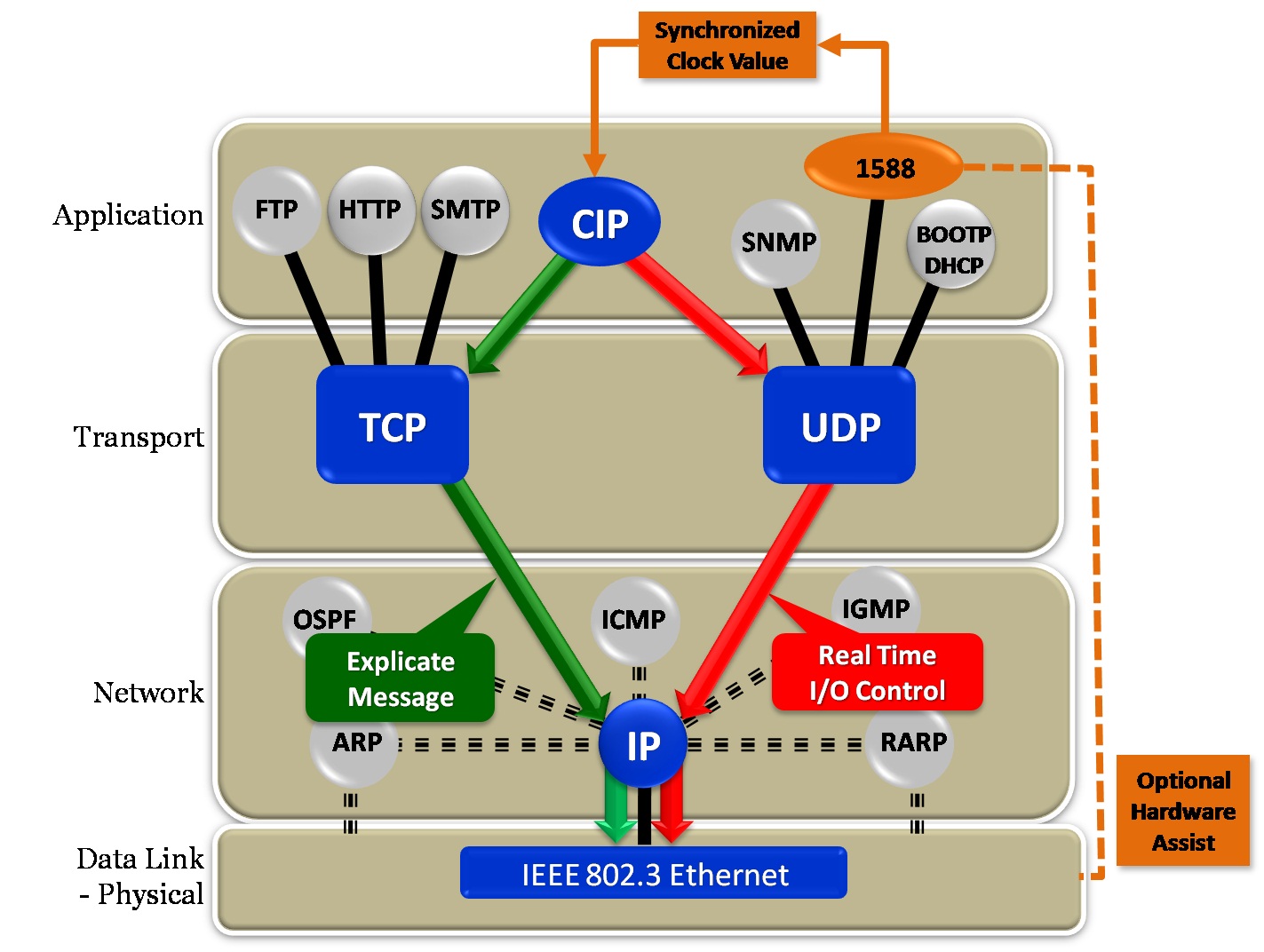
EtherNet/IP Enabling Network Convergence
.jpg)
Figure 2: The
EtherNet/IP is a CIP adaptation of
Safety over EtherNet/IP
Like other digital safety protocols using a “black channel” approach, CIP Safety™ is an extension to the application layer. It provides a set of highly integrated safety services that leverage the underlying communications stacks of the standard CIP networks to transport data from a source to a destination. CIP Safety is certified to be compliant with the functional safety standard International Electrotechnical Commission (IEC) 61508 up to safety integrity level (
.jpg)
Figure 3: CIP Safety’s end-to-end protocol gives safety responsibility to end nodes
As shown in Figure 3, CIP Safety’s end-to-end protocol gives responsibility for ensuring safety to the end nodes – rather than the bridges, routers, or intermediate nodes. If an error occurs during data transmission or in the intermediate router, the end device will detect the failure and take the appropriate action. Since the safety coding and not the underlying communication layers ensure data integrity, the underlying communication layers can be interchanged and intermixed even across subnets. CIP Safety allows users to mix standard and safety devices on the same open network.
Time Synchronization over EtherNet/IP
Use of time in a control system generally is applied to time-stamping applications and frequency-based applications. CIP Sync™ is a time-synchronization extension based on the IEEE 1588 (IEC 61588) standard – Precision Clock Synchronization Protocol for Networked Measurement and Control Systems – commonly referred to as the Precision Time Protocol (PTP). PTP provides a standard mechanism for distributing Coordinated Universal Time (UTC) across a standard Ethernet network of distributed devices. By time stamping in UTC, events can easily be compared across time zones without having to be adjusted for geographic origination.
CIP Sync allows users to base control on true time synchronization rather than the limited event synchronization model used historically. Using a 100-megabits-per-second switched Ethernet system, advanced testing shows CIP Sync can deliver time-synchronization accuracy of less than 500 nanoseconds between devices, meeting some of the most demanding real-time applications’ requirements.
.jpg)
Figure 4: CIP Motion provides full compliance with standard IEEE 802.3 Ethernet
Reference Architectures for Manufacturing
To help bridge the gap between these groups, Rockwell Automation and Cisco are working together to deliver design guidance through Converged Plantwide Ethernet Architectures. These resources provide education, design guidance, recommendations and best practices to help establish a robust and secure network infrastructure.
(2).jpg)
Figure 5: Manufacturing Framework
Built on technology and manufacturing standards common between IT and manufacturing, Converged Plantwide Ethernet Architectures follow standards, such as IEEE 802.3 Ethernet, Internet Engineer Task Force (IETF), Internet Protocol (IP) and CIP. Using standards to establish a manufacturing framework, as shown in Figure 5, This design guidance creates a foundation for network segmentation for network management and policy enforcement, such as security, remote access and Quality of Service (QoS). The joint architectures follow standards such as
For more information, kindly contact 03-8925 2828 or email [email protected].