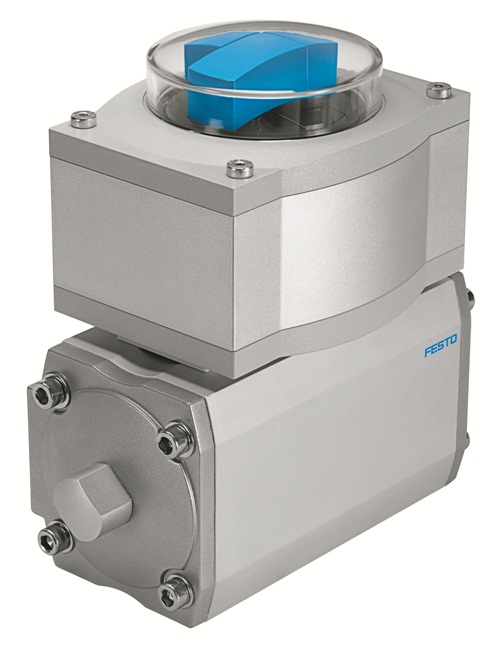
Precise position detection in process industries

Analogue position sensor SRAP for quarter-turn actuators and process valves

Transporting, metering and filling gaseous, paste-like and liquid media in the process industries calls for robust and reliable components. Dependable, hard-wearing and precise sensors are vital for the accurate control of the actuators used to activate shut-off devices such as ball or gate valves. The ideal solution is technologies which operate by contactless means and are thus unaffected by dirt, such as the Festo analogue position sensor SRAP.
In the tough environments of the process industries, pneumatic quarter-turn actuators are, thanks to their robustness, the components of choice for the activation of gate valves, butterfly valves and ball valves. These actuators are installed directly on the process valves in piping systems and open and close these to control the flow of medium. Precise position detection is vital in order to ensure that mixing and stirring stations are fed with accurately metered quantities of various materials. Analogue position sensors, like the SRAP from Festo, which feed signals for the current positions of valves to a controller, are a perfect fit.
Contactless mode of operation
The sensor box SRAP and the quarter-turn actuator are mechanically connected via a shaft. The rotary motion of the shaft, which is fitted with a magnet, is detected by a Hall sensor. The sensor and shaft are not in contact, since the sensor is integrated into a printed circuit board. This “contactless” principle has many advantages: the sensor box is unaffected by vibration, mechanical wear or abrasion, which means that its service life is considerably increased. The sensor delivers a stable signal at all times and measuring accuracy is very high.
Aluminium body for protection
A robust, corrosion-resistant and easy-to-clean aluminium “Clean Design” body protects the sensor from mechanical damage. The sensor box also fulfils the requirements for protection class IP 65 and is both polarity-safe and resistant to short circuits – vital criteria for use in areas with a potentially explosive atmosphere (ATEX zone 2/22 (3GD)).
Teach-in function for angle of rotation
A zero point and an angle of rotation of between 0 and 270° can be easily set on the sensor by means of a teach-in function. The sensor also supplies simple diagnostic data, for example in cases where the end points of the defined measuring range are exceeded.
Position detection with Hall sensor technology
The SRAP exploits the advantages of Hall sensor technology. It is completely unaffected by dirt or water and offers lower costs, thanks to the fact that the technology is very inexpensive. The principle is simple: if a current is passed through a Hall sensor and this is then brought into a magnetic field oriented at a right angle to the sensor, this will deliver an output voltage which is proportional to the product of the magnetic field and the current. If the current is known, the strength of the magnetic field can be measured, and vice-versa.
The analogue signal output covers not only the valve positions “Open” and “Closed” but also the entire angle of rotation. The sensor is thus able to provide an accurate indication of the current position of a valve.
Particularly in process industries, pneumatic drives are the #1 choice. In comparison with electric drives, their investment, installation and operating costs are more than 50 % lower in some cases and they are maintenance free for the whole of their service lives. The analogue position sensor SRAP is just as robust and inexpensive as pneumatic drives and provides an accurate means of controlling them.