Pneumatic control cabinets save energy and water

User-friendly automation concepts for fixed-bed filters
.jpg)
Hand wheel or automated process valve? The worldwide trend is clearly towards automation. This is because automation saves energy and water, particularly rinse water, and improves operating reliability. This is illustrated using the example of the pneumatic automation of fixed-bed filters in a water works. Ready-to-install control cabinets with control panels are the key feature here.
Fixed-bed filters of open or closed construction are an important element of water processing in water works or purification plants. They remove turbidity, non-bio-degradable content and soften, de-acidify or harden the water.
Flexible automation
Pneumatics offer greater functionality in process valve control. They can be used to forcibly control safety-relevant functions depending on the operating situation in question. This relates in particular to the behaviour of the process valves during a power failure if there is no emergency power generator available. Specifically, this refers to the initial position of the process valve when the system is inoperative or on starting up and the safety position of the process valve in the event of a power failure: forcibly closed, open or pausing.
The number of fixed-bed filters can range from two in small local water works to 48 or more filters in water works for major cities. An automation concept must therefore be decentralised and flexible, and combine pneumatics and electrics. The pneumatic valve terminal is particularly suited to this. It creates the link between the pneumatically operated process valves and the limit switches, the measuring devices and the controller or process control level.
Valve terminal in control cabinet with integrated PLC
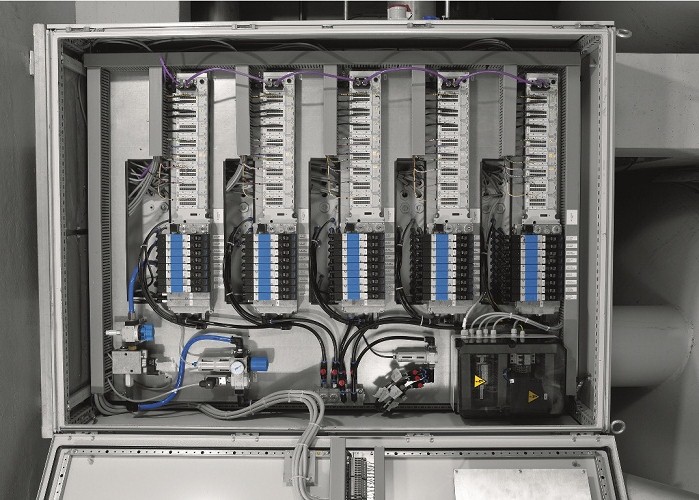
One forward-looking technical development is a control cabinet from Festo which plant operators can use to centrally configure all parameters for controlling the process valves of a fixed-bed filter. The key differences to the conventional solution are: valve terminal instead of individual valves directly on the drive, integration of a pneumatic manual operation level and elimination of the positioner by dividing this function into three elements.
One control cabinet is assigned to each fixed-bed filter. The main components of the control cabinet are a touchscreen for system operation and a PLC. The link to the coordinating level is made via Ethernet to the higher-level PLC and the visualisation of the process. The PLC in the control cabinet controls the process valves, the higher-level PLC coordinates the backwashing of the individual fixed-bed filters.
Positioner function
A manual operation level also makes it possible to operate the system from the control cabinet in the event of a breakdown or without electrical power. The control cabinet is a robust, flexible solution for the control valve. It can be operated even without electrical power. Regulator parameters can be configured centrally in the control cabinet. The CPX/MPA valve terminal is the key component core of the control cabinet.
The positioner function is split into three elements: feedback of the process valve position by a box with a 4..20 mA analogue output, activation of the drive by a 5/3-way solenoid valve on the valve terminal and shifting of the regulator software to the PLC.
Ease of use
The compressed air quality requirements are therefore lower than if using an intelligent positioner. High flow rates of the solenoid valves permit rapid movements and safe operation even with larger drives. The process valve can be configured manually if there is no electrical power. However, the greatest advantage when it comes to handling is that the system operator no longer has to run to the process valve, as he makes the parameter changes for regulation directly in the control cabinet.