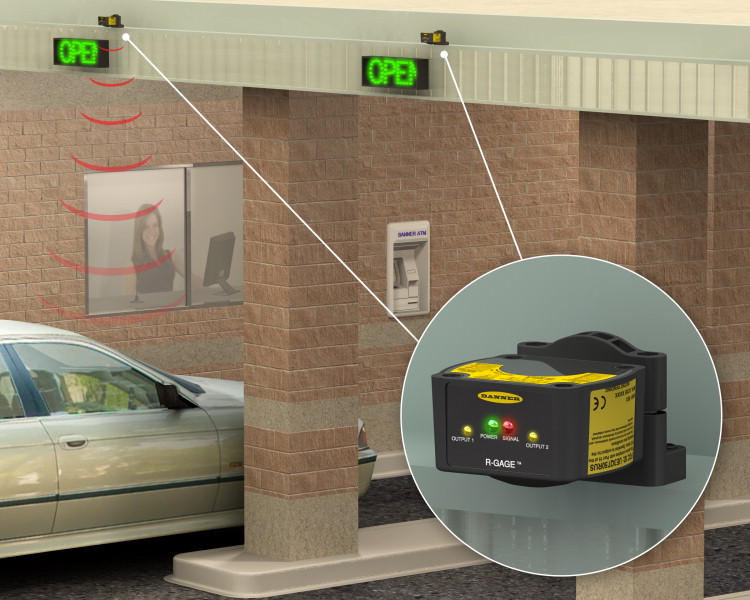
Banner's R-Gage™ QT50R Radar Sensors Are Industry Pioneering Detection Solutions

Among the unique products developed exclusively by Banner Engineering Corp. are the R-Gage™ QT50R Adjustable Field and Retroreflective sensors.

Originally made for train detection applications, the R-Gage™ QT50R sensor has succeeded where photoelectric, ultrasonic, and magnetic sensors have fallen short, primarily because of its use of radar technology to sense objects. "Magnetic sensors were affected by the electric current of trains, ultrasonic sensors were susceptible to the interference caused by the wind of passing trains blowing away the return signal, and optical sensors became impractical because dirt and dust accumulated and eventually inhibited the sensor's ability to deliver accurate results," said Ashley Wise, Development Engineer at Banner Engineering. "The solutions to those problems were not always practical or cost-effective, so we developed the QT50R Adjustable Field sensor and it has proven to be a successful and efficient solution." The Adjustable Field radar sensor emits a well-defined beam of high-frequency radio waves from an internal antenna and processes the signal reflected back to the receiving antenna. Other applications for which the QT50RAF radar sensor is ideal include detecting vehicles on roads and near intersections, boat detection for locks and dams, proximity detection for large shipyard cranes and cargo, car counting for parking ramps, gates, and drive-thrus, and subway and light rail logistics.
Recently, the QT50R Retroreflective model was developed and introduced to complement the Adjustable Field model. Like the Adjustable Field model, the Retroreflective model emits a beam of high-frequency radio waves. However, there are several key differences between the two radar sensors — primarily, the Retroreflective model reliably senses stationary targets with poor or no radar reflection thanks to the use of a reference signal, or retro-target. Additionally, the sensor ignores objects in the background beyond the retroreflective target, and the effective sensing beam of the Retroreflective model is much narrower, creating a more focused sensor. Finally, the Retroreflective model can also sense targets up to the face of the sensor, thus eliminating any sensor dead zone. "We believe the functionality, utility, and price of both radar sensors will set them apart from the competition," said Wise. Some common applications of the Retroreflective model include tollbooths, gate control, parking ramps, train detection and shipyard logistics, and truck trailer detection at loading docks.
Both sensors feature FMCW (true-presence) radar to detect moving and stationary objects and offer simple sensing field configurations. The radar sensors operate within Industrial, Scientific, and Medial (ISM) telecommunication bandwidth with no special license required, and their rugged IP67 housing is built to withstand harsh conditions, making it impervious to environmental elements such as dust, rain, fog, snow, sun, and wind.
The maximum distance an R-Gage™ can sense targets will always depend on the size and shape of the target. The standard adjustable field sensor is limited to 15 meters. However, specials can be ordered with ranges out to 40 meters. Specials can also be ordered with advanced capabilities such as two independent sensing zones, narrower beam patterns, analog output, velocity/direction, heartbeat for health monitoring, and higher gain antennas for more sensitive detection.
R-Gage™ QT50R output properties and sensing field can be configured with simple DIP switches. Retro-target TEACH-IN is performed via remote TEACH. Both sensors are available in cabled or M12 quick-disconnect models.
About Banner.
Banner Engineering is the world's leading manufacturer of indicator lights, photoelectric and ultrasonic sensors, vision sensors, electronic machine guarding systems, wireless networks, fiber optic assemblies and precision measurement systems.