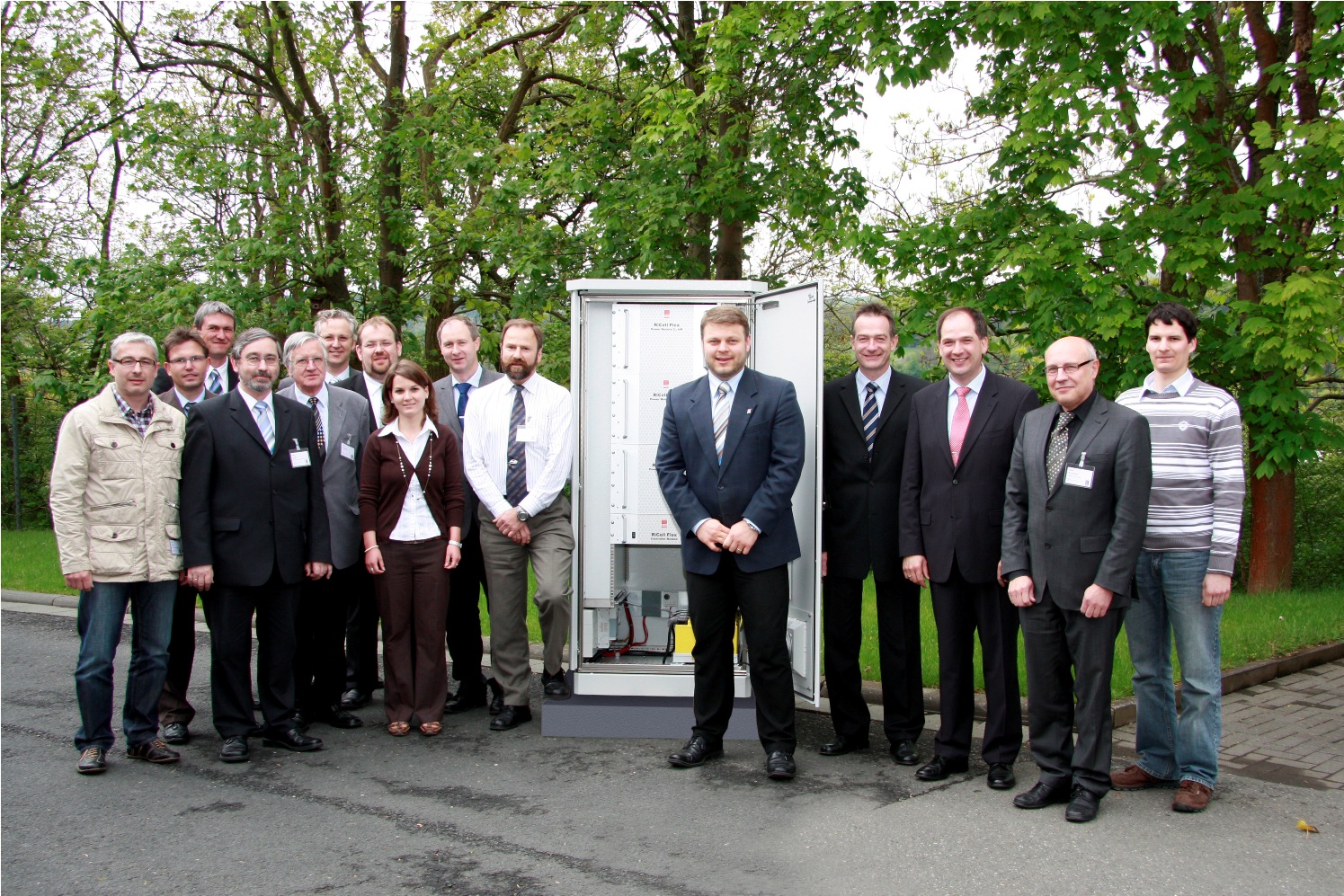
Rittal: Innovative power supply for rail technology discussed

In terms of energy consumption, - back-up power supplies that use internal combustion engines such as diesel generators are now obsolete. New energy concepts are called for to supply power to rail safety installations. Today, fuel cell systems, with their advantages, represent a compelling alternative. This was the conclusion reached by the VDEI (Association of German Railway Engineers) at their Expert Committee Meeting held at Rittal's headquarters in Herborn on 12 May. This specialist event focused on the issue of "Innovative power supply for rail technology".

Nowadays, the demands placed on rail safety installations are very high. - These include 100 percent redundancy, a stable power supply, as well as high reliability and flexibility due to modular design and low maintenance costs. In his lecture, Lutz Westphal from EBC Eisenbahn-Cert of the Federal Railway Authority (EBA) outlined the opportunities that arise from replacement power supply in railway technology. His conclusion: "From an energy perspective, replacement supplies based on internal combustion engines are outdated". The transformation of electrical energy using motor generators is much less efficient than with static inverters." The technologies currently being used on German railways, above all the deployment of diesel generators, no longer represent the state of the art.
The presentation by Andreas Henschel, of German Railways' QA department, detailed the drawbacks of diesel engines. These include poor levels of efficiency (between 0.40 and 0.45) and thus energy losses of 55 to 60 percent, high maintenance and repair costs, as well as pollutant emissions. In particular, this aspect of environmental pollution is no longer acceptable any more, and needs extensive filtering measures or even new equipment.
The talk by Hartmut Paul, of the Mechanics and Climate Control Technology Management at Rittal, explained the benefits of fuel cell technology, powered by hydrogen and oxygen, as a convincing alternative to diesel generators. He mentioned the limited availability of another 50 to 80 years of fossil fuels and the increasing demand for energy as reasons for using hydrogen as an energy source. Hydrogen is the most abundant element in the universe and is regarded as an ideal storage medium for the renewable electricity networks of the future. He also mentioned the fact that when introducing a new energy system, it basically takes about 50 years to penetrate ten percent of the market. "It is now the time to use hydrogen as a storable and universally employable renewable source of secondary energy, free of carbon dioxide emission." Today, hydrogen is equal to conventional energy sources as far as safety is concerned.
One major benefit of Rittal's RiCell Flex fuel cell technology, which this year has been nominated for the Hermes Award, is the environmentally friendly, zero emission energy conversion, as well as the high overall efficiency of up to 54 percent. One novel feature is that the system is consistently modular. It can be scaled from 2.5 to 50 kilowatts in twenty individual steps and can thus be adapted to the needs of different users. Thanks to the modular technology used, the amount of maintenance work needed is very small. The air-cooled fuel cell system only produces heat (and slightly humid exhaust air) as waste products. Since energy conversion is performed without any moving parts, fuel cells also operate without generating any annoying noise. Alongside their traditional use as an emergency power supply, they can also provide the energy needed to deal with expensive peak loads.
Finally, the Expert Committee members discussed the possible uses of new technologies in the power supply of rail safety installations. In addition to replacing individual components by new technologies such as fuel cells and dual UPS units, a new concept of power supply systems for use in railway point switching systems or in level crossing protection was also discussed. The participants agreed that these concepts provided secure supplies and were cost-efficient.