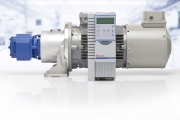
Variable-Speed Pump Drives Save Energy and Space in Machine Tools

Rexroth hydraulics up to 70 percent more efficient

Variable-speed pump drives with Rexroth BlueHydraulics technology reduce hydraulic energy requirements by up to 70 percent while considerably lowering average noise emissions and minimizing installation space. This does not come at the expense of performance or functionality, however, which can even increase.
Variable-speed pump drives are becoming a more popular replacement for controlled variable pump units because they substantially reduce the energy requirements of machine tools and simplify design. A frequency converter actively adapts the speed of the pump motor to current requirements. Lowering speed in the partial-load range reduces the energy consumption of hydraulic units in machine tools by 30 to 70 percent, depending on cyclical characteristics. Average noise emissions are also reduced by up to 20 dB(A) as a result, making it possible to do without elaborate encapsulation for the hydraulic unit in many machines. Positive side effect: Active regulation reduces the amount of heat absorbed by the hydraulic fluid, thereby minimizing cooling requirements.
An automation specialist, Rexroth supports the trend toward more compact machine tools. Automated hydraulic units with variable-speed pump drives need less space, since smaller fluid reservoirs frequently suffice and the cooling unit otherwise required is no longer necessary. Rexroth offers a wide range of hybrid drives in different performance classes. New PGH-3X internal gear pumps specially designed for variable-speed operation were developed by Rexroth as an integral component of a full-time, actively-regulated flow control system and improve efficiency throughout the entire speed range, to over 3,000 revolutions per minute.
Rexroth simplifies electrical commissioning, since all particulars of the fluid technology are already defined in the software for the hybrid variable-speed pump drives, which interface with the controller like all other electric drives and can be integrated seamlessly into any automation architecture. Intelligent frequency converters further facilitate condition monitoring.