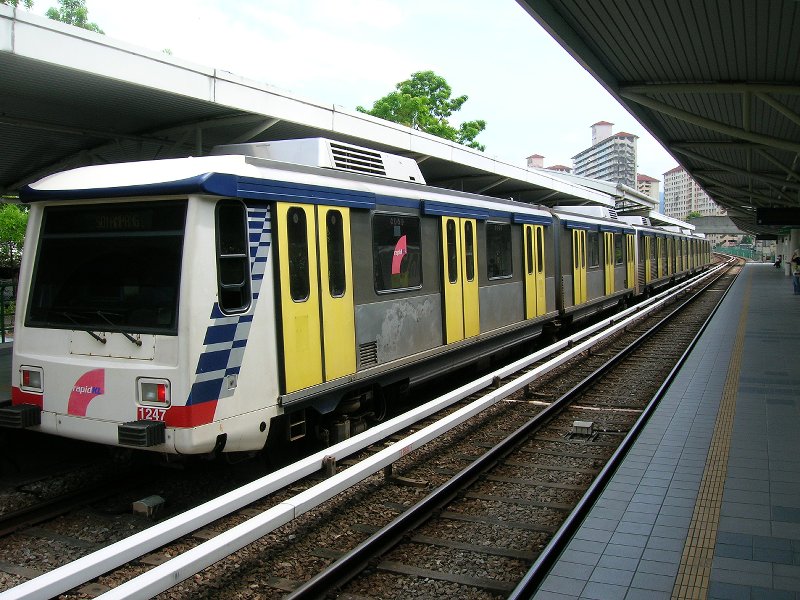
Moxa Secures Industrial Wireless Network for Enhanced Passenger Security on Malaysia Light Rail Transit

Malaysia Light Rail Transit chose Moxa's reliable industrial wireless solutions to create cross-station communications to enhance train safety for a project that was completed in 2009.

Light Rail Transit (LRT) is a form of urban rail public transportation with low speed and low capacity. LRT falls between streetcars and the heavier rail/metro system. It is usually used to link urban hubs with low density residential areas. LRT coach status monitoring and real-time passenger information updates are important components of fully-automated driverless LRT systems deployed in modern cities around the world. Because they are mobile applications, LRT systems increasingly rely on wireless LAN networks to support in-train surveillance and train-to-ground data transfers.
In Malaysia, the LRT operator operated several stations along the LRT route, with wireless LANs deployed as communication links between the carriage and ground network because of WLAN's clear advantages in lower maintenance and deployment costs. They selected Moxa's AWK-5222, which has a dual RF design and can be configured for AP-client connection mode: one path operates at IEEE 802.11b 2.4 GHz and the other path uses IEEE 802.11a 5 GHz, to better avoid RF interference. They also took advantage of Moxa's unique "Redundant Roaming" feature which combines the speed of 100 ms Turbo Roaming with the reliability of dual-RF redundancy. This architecture is a great way to get around the interference inherent in a train station's complex RF environment.
"Moxa's industrial-grade WLAN technology improves train security by enabling information flow between the trains and the stations. Station operators can transfer information to and from trains, including status of other trains, track conditions, and unexpected events," explained Jackie Shi, senior manager of Moxa Industrial Wireless division. "For harsh rail environments, the Malaysian LRT operator required industrial-grade wireless LANs that meet higher standards of industry-proven ruggedness, such as EN50155/EN50121-1/-4. For performance and reliability reasons they also needed a stable wireless network despite the RF interference that is prevalent in train stations. Moxa's WLAN solution uses multiple redundant mechanisms, so you can be sure that your entire network will always be in service."