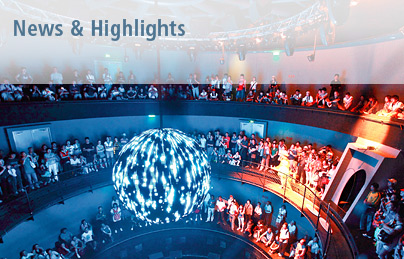
Beckhoff technology controls the movement of the energy center in the German pavilion at EXPO 2010 in Shanghai

The Expo 2010 in Shanghai closed its gates on October 31, 2010 after welcoming over 72,000,000 visitors. This astonishing number of attendees beat all previous world exhibition attendance records. The highlight of the German pavilion was the so-called ‘energy center,’ with an interactive pendulum, which could be made to swing by calls from the visitors and projected pictures on the subject of ‘balancity – city in balance.’ Developed by the University of Stuttgart in cooperation with Milla und Partner Agentur & Ateliers, Beckhoff technology works in the background as part of the complex drive equipment in the pendulum.

The Federal Republic of Germany presented itself at the Expo 2010 as a country that draws its particular quality of life from the cultural versatility and contrariness of the German cities. Under the motto ‘balancity,’ the aim, in connection with the guiding theme of the Expo – ‘Better City, Better Life’, was to show how cities can gain quality of life and versatility from the harmonic interaction of all elements and forces. Visitors to the German pavilion were accordingly guided by a future vision of urban life, which was borne by the balance between renewal and preservation, innovation and tradition, urbanity and nature, community and individual, work and leisure, and globalization and national identity.
The highlight of the German pavilion was the interactive show in the energy center: A ball with a diameter of three meters, fitted with almost 400,000 LEDs, was suspended on a thin rod. The ball, weighing around 1.2 tons, was made to swing by the calls and hand claps of the visitors via a drive integrated into the ceiling of the pavilion. Even the direction of swing of the pendulum could be influenced by the acoustic signals. Pictures and films from Germany were created on the ball. The energy from the interaction of the different forces was reflected by the intensification of the colors and the acceleration of the circular movement.
The concept and development of the interactive pendulum arose out of a joint project of the Institute of Technical and Numeric Mechanics (ITM), the Institute of Control Engineering of Machine Tools and Manufacturing Units (ISW) and the Institute for Machine Elements (IMA) at the University of Stuttgart, together with the Stuttgart-based exhibition design company Milla und Partner. The control and drive concept, the design and calculation of the lifetime of the pendulum rod as well as the sensors were planned and developed by the University of Stuttgart. The drive concept ensures that the pendulum is reliably set in motion as desired and safely decelerated again. The basis for this joint. Metron GmbH was entrusted with the design and construction of the drive equipment. The movement of the ball is controlled by a Beckhoff C6140 Control Cabinet Industrial PC and a CP7902 Control Panel. The basic functions of the controller were programmed using the Beckhoff TwinCAT PLC automation software and TwinCAT HMI is used for the visualization. The safety functions of the machine are guaranteed by the TwinSAFE software-based safety solution from Beckhoff. Commissioning was performed jointly by the University of Stuttgart, Metron GmbH and Beckhoff.
The owner of the pavilion is the Federal Ministry of Economics and Technology. It commissioned Koelnmesse International with the coordination of the preparations for and running of the German pavilion. The German Pavilion EXPO 2010 Shanghai Consortium (ARGE) was responsible as the general contractor for the planning and construction of balancity. Schmidhuber +Kaindl from Munich designed the architecture of the pavilion and were responsible for its general planning. Milla und Partner from Stuttgart were responsible for the exhibition and media design. NÜSSLI (Germany) from Roth near Nuremberg took care of the project management and the building work.